
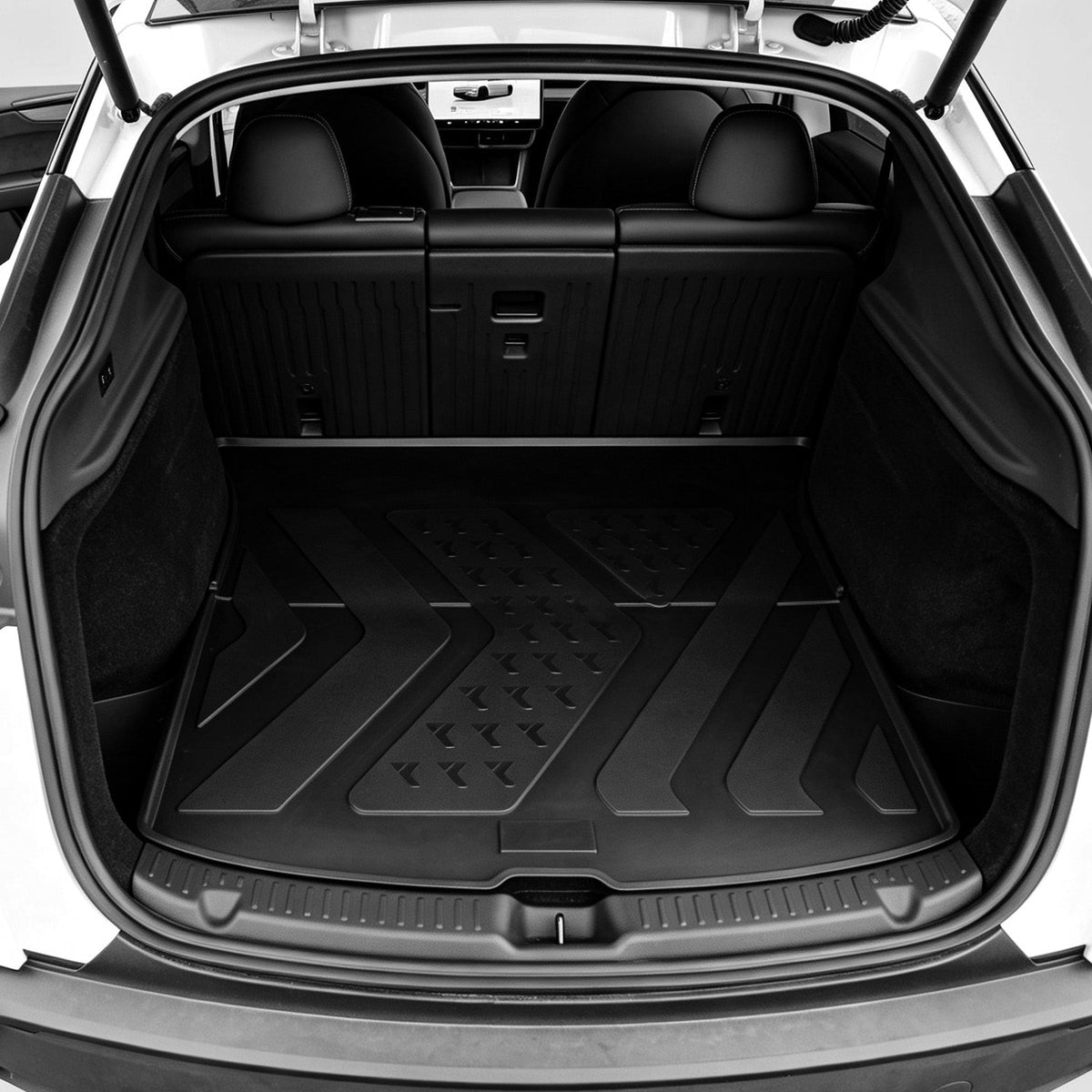
Shop for Tesla floor mats and many products can look surprisingly similar on a screen: black TPE, raised edges, molded channels and vehicle-specific shapes. But how a liner is manufactured can influence its geometry, edge design, surface finish and overall feel.
Two common approaches are thermoforming and injection molding. Neither term alone tells you whether a finished product is good or bad. The important question is what each process allows a manufacturer to control.
What is thermoforming?
Thermoforming starts with a sheet of thermoplastic material. The sheet is heated until pliable, formed over or into a tool, cooled, and then trimmed to its final outline. It is an efficient way to create large three-dimensional parts and is widely used across automotive and consumer products.
For floor liners, the final result depends on the material, sheet thickness, tooling, forming conditions and trimming process. A well-engineered thermoformed liner can provide excellent everyday protection.
What is injection molding?
Injection molding starts differently. Material is heated and injected into a closed mold cavity that defines the final three-dimensional part. Once the material cools, the molded part is removed from the tool.
Because the mold defines the part rather than shaping a pre-existing flat sheet, injection molding gives designers direct control over details such as molded edges, local geometry, transitions, textures and other features built into the tool.

Why does the process matter for floor mats?
1. Three-dimensional geometry
A floor liner is not simply a flat mat. It has to transition from the floor into sidewalls, corners and vehicle-specific contours. The manufacturing process affects how those shapes are created and how much control designers have over them.
2. Finished edges
Edges are one of the easiest places to see manufacturing differences. Thermoformed parts are typically formed and then trimmed. Injection-molded parts can have the finished edge defined directly by the mold.
3. Surface texture
Texture is more than decoration. It changes how the product looks under cabin lighting, how it feels to the touch and how visible dust or wear may appear. Injection molding allows texture to be designed into the mold surface.

4. Material distribution
Good floor protection is not simply a contest to make the thickest mat. What matters is using material intelligently across the part while maintaining the geometry and feel the product was designed to deliver.
Why we chose injection molding for MoldedFit
When we developed MoldedFit, our goal was not merely to make another waterproof Tesla liner. We wanted a floor protection system with a softer, substantial TPE feel, clean molded edges, restrained matte texture and a finished appearance that complements the vehicle interior.
That is why MoldedFit uses one-piece injection-molded construction. The process supports the design language we wanted: precise three-dimensional geometry, controlled transitions and a refined molded finish.
Does injection molded automatically mean better?
No. Manufacturing method is only one part of product quality. Material formulation, tooling quality, vehicle data, engineering tolerances and quality control all matter. A poorly designed injection-molded liner can still be a poor product, just as a carefully engineered thermoformed liner can perform very well.
For buyers, the best approach is to look beyond the manufacturing label. Examine the fit around the pedals and console, the edge finish, the material feel, the surface texture, the coverage and the complete installed appearance.
The MoldedFit approach
MoldedFit was developed around three ideas: Fit, Feel and Finish. Precision should be visible in the installed shape. Premium should be something you can feel in the material. Refinement should show up in the small details.
That is what we mean by The Refined Floor Protection System.