
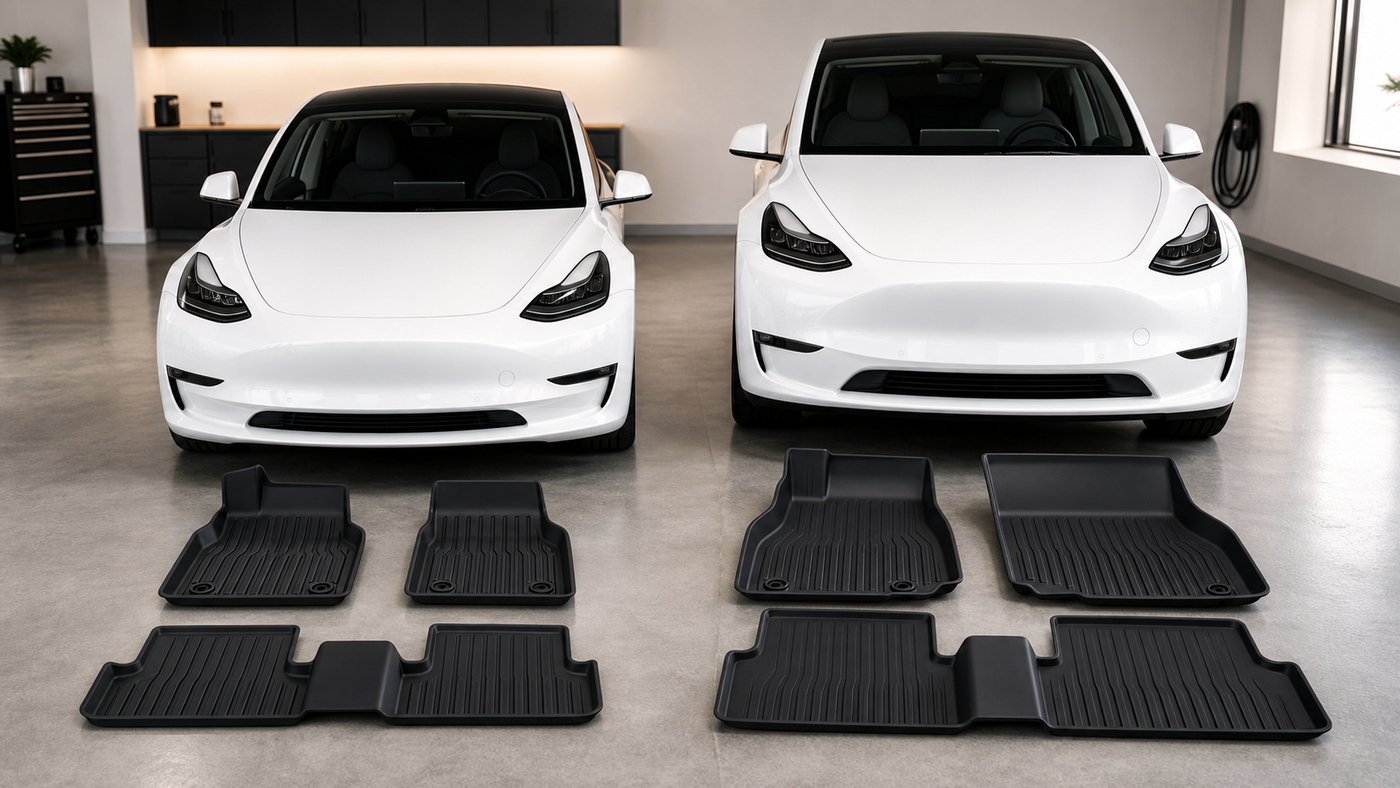
The platform-sharing myth
Tesla loves to talk about how the Model 3 and Model Y share ~75% of their parts. Most of that shared DNA is underneath the skin — battery pack, drivetrain, suspension subframes, electrical architecture. The body and interior are where the two cars diverge hard, and the floor is one of the places they diverge the most.
Which is why a common new-owner mistake — "I had Model 3 mats, I just bought a Model Y, I'll reuse them" — doesn't work. Neither does the reverse. And the Amazon listings claiming "fits Model 3 and Model Y" are either selling a generic tray-style mat that fits poorly in both, or quietly shipping different molds depending on which SKU you ordered.
The five ways the floors actually differ
1. Ride height changes the footwell angle
The Model Y sits higher. Same pedals, different floor plane relative to the seat. A mat molded for the Model 3's flatter floor angle will tilt forward in a Model Y and leave a visible wedge-shaped gap at the firewall.
2. Cabin width is different
The Model Y is wider at the shoulder and wider at the floor. Front driver's mats for a Model 3 come up roughly 40–50mm short at the outside edge of a Model Y — right where your left foot parks when it's not on the pedals.
3. Rear tunnel geometry
The Model Y's rear floor is almost flat because of its crossover packaging. The Model 3's rear floor has a more pronounced tunnel crown. A one-piece rear mat cut for a Model Y will bridge correctly in the Model Y, but drape wrong in a Model 3. And vice versa — a Model 3 rear mat in a Model Y floats.
4. Third row (Model Y 7-seater only)
The Model Y 7-seater has a third row; the Model 3 never has. If you're cross-shopping, the Y's 7-seater floor mat set has three rows of mats. The Model 3 set has two. This is obvious in the product listing but not obvious when you're mid-order.
5. Cargo floor
Both cars have a hatchback-ish cargo area (Model Y is a true hatch, Model 3 is a sedan trunk), but the floors are entirely different shapes. Trunk liners are not cross-compatible, full stop.
Why Amazon "fits both" listings survive
They survive because most buyers don't notice small fitment problems. A mat that's 40mm short at one edge looks fine from the driver's seat. The gap is only visible when you open the door. By the time the buyer notices — typically when they vacuum — the return window is closed.
The listings that claim dual compatibility are also often sold through multiple storefronts with different stock under the hood: order a "Tesla Model 3 / Model Y floor mat" and you might get a Model 3 mold in a Model Y box. We've seen this happen in our own returns data when customers bring us competitor mats for comparison.
What a Model 3-specific mat looks like
Properly tooled Model 3 mats have:
- Narrower front driver's mat (by ~40mm vs a Model Y equivalent)
- Sharper tunnel crown contour in the rear one-piece mat
- Rear mat front edge cut for the Model 3 seat base (not the flatter Model Y base)
- Trunk liner cut for a sedan floor, not a crossover hatch
- No third-row mat in the kit
Our custom-fit Tesla Model 3 floor mats are designed on a 3D scan of an actual Model 3 — no "platform-share" shortcuts, no shared tooling with the Model Y program.
What a Model Y-specific mat looks like
Wider front mats, flatter rear floor coverage, third-row-optional rear kit, and a taller cargo liner (the Y's cargo area is deeper). If you own a Model Y, you want the Model Y-specific range, not a cross-compatible product.
The $80 mistake we see most often
A household that already owned a Model 3, then bought a Model Y as the "family car," tries to stretch the Model 3 mats across the new Y for the first week. Coffee spills. The coffee hits the gap where the Model 3 mat comes up short against the Model Y's wider floor. The carpet stains. A year later, at trade-in, the detailer quote to remove the stain is $180.
The $80 saved by skipping Model Y-specific mats on day one costs $180 at trade-in plus however much resale value the detailer discount absorbs. It's a bad math problem that shows up in used-car forums constantly.
The cross-car owner case: what to buy when you have both
If your household owns one of each — which is common, especially in families that kept the Model 3 as a commuter when they added a Model Y — you want two separate sets:
- A Model 3-specific kit for the 3 (Essential or Pro depending on use)
- A Model Y-specific kit for the Y (plus a third-row mat if it's a 7-seater)
The mats are not visually identical up close — Model Y mats are physically larger and weigh more. But at arm's length they look the same, which is why households sometimes mix them up. Label the underside with painter's tape if you're swapping between cars for cleaning.
The bottom line
Platform-sharing is marketing. Footwell geometry is engineering. The Model 3 and Model Y don't share a footwell, so their mats aren't interchangeable no matter how the listing is worded. Buy model-specific, keep the receipt, and your interior won't pay the price for a mid-order shortcut.
Shopping for a Model 3? Start with the Tesla Model 3 floor mat collection — every kit is generation-tagged and Model 3-specific, so there's no crossover confusion at checkout.